Thursday, July 25, 2013

Goat Cheese Chocolate Cake

Even just a few dairy goats will generate a ridiculous amount of chèvre. These days I am making anywhere from 10 - 15 oz of cheese per day with just two milkers. As such, I have been coming up with some creative uses for goat cheese. For example, I now make the best and, at current chèvre prices of $1.00/oz, incredibly expensive mac and cheese.

However, this new recipe "takes the cake". After a cursory internet search revealed no such other recipes on the entire Internet (of the first six google hits) I thought I would put it down here for posterity.

So, if you want to make a great tasting chocolate cake and have some goat cheese sitting around (or are willing to spend $10+ for a cake) read on...

Goat Cheese Chocolate Cake:

Ingredients

  • 10 - 12 oz of fresh creamy chèvre 
  • 1/2 cup goats milk, divided
  • 3 egg yolks
  • 6 oz of chocolate chips (more if you like more chocolatey goodness)
  • 1/4 cup sugar
  • 1 tsp vanilla
  • 1 tsp baking soda
  • 1/2 tsp salt
  • 2 cups flour
  1. Heat 1/4 cup of milk and chocolate chips in a double boiler until melted and smooth.
  2. In the mean time, whisk egg yolks, salt, and sugar in a bowl until the eggs are a light yellow and fluffy (about 2 - 3 minutes)
  3. Pour a little of the hot cream mixture into the eggs to temper, then return the whole thing to the double boiler. Whisk until thick, roughly 15 minutes. Do not allow to boil. Cool the chocolate-egg mixture in the fridge until firm (about an hour or so).
  4. When it is cool, whip the eggs and chocolate mixture with the goat cheese until smooth. Add the vanilla and stir to combine.
  5. Combine the flour and baking soda and add it to the cheese mixture a little at a time. If it gets too thick, alternate with some additional milk until all the flour is combined. You should get a cake batter consistency that is a little on the stiff side.
  6. Pour into a buttered pan and bake at 350 until an inserted toothpick comes out smooth (depends on the pan, but my bread pan took about 30 minutes).
All that's left of this tasty goodness!

You can make up a frosting (with goat cheese, of course) but I just eat it plain.

Next stop, goat cheese chocolate chip cookies!


Monday, February 18, 2013

Red Air Data


Dear Rep. Brad Dee:

Regarding your recent column:


As a concerned resident, I am doing everything I can to reduce emissions on red air days. We’ve lowered our thermostat and don’t burn wood on red air days. We drive a low emission vehicle, carpool, bike, or take mass transit, and pool all our trips. 

But, with apologies to you and Governor Herbert, I must take issue with some of the numbers being used to describe the sources of pollution that affect us all during the winter inversions. The Utah DAQ - along with the Governor and your recent column - report that vehicle emissions represent 57% of the inversion pollution, with industry accounting for only 11%. Drive less, you tell us, and do your part.

However, automobiles are not the largest source of PM 2.5 emissions along the Wasatch Front. According to the DAQ 2012 Annual Report, on-road emissions account for only 13% of PM 2.5 sources (see figure on page 22 of the report, available at the DAQ web site). Industry point sources account for 24%, and other area sources account for 49% of PM 2.5 emissions. Remember, the red air action alerts are measured by the amount of PM 2.5 in the air. PM 2.5 also contributes the most to the health risks on red air days.

To suggest that industry only contributes 11% to the pollution problem during inversions is disingenuous at best. Kennecott’s operation alone accounts for over 66% of PM 2.5 emissions in Salt Lake County. 

We may be at the mercy of our geography, but nobody is forcing us to operate refineries and open pit mines on red air days. If you are going to use data to ban wood burning and ask us to drive less, please use data to - at the very least - ask industries to not operate these point sources on red air days. 

Monday, December 5, 2011

Heroes


Recently I've developed some unlikely heroes, at least for a physicist. One of them is Joel Salatin.
If you run with back-to-the-landers or the Mother Earth News crowd, you'll recognize Joel as the the man behind Polyface Farms. He and his family have been pioneers (since the '60s) of natural methods of raising livestock. Today, in addition to running Polyface, Joel is the voice of the anti-industrial farming movement. If you are into local food, if you want to be able to buy food directly from the farmer, he is your advocate.
Joel spends a great deal of time fighting what he calls "the food police" or, in his colorful way of phrasing it, the "US-duh". If you couldn't already gather, he has some pretty strong feelings about food regulation. His thesis: food regulations favor the large producers that can afford to comply, and the little guy - aka the small farmer - goes out of business due to the high overhead of compliance. He details this in his book Everything I Want to do is Illegal. It is an entertaining read, and the only book I know of that appeals to both "save the environment" liberals and "small government" conservatives. Perhaps appeal is the wrong word, because he lambasts both groups, but it beats the hell out of Ann Coulter or Al Franken. And it is about farms.
Anyway, my point: Joel is a hero. He strongly believes in his cause, he is working tireless as an advocate for small farming and local producers and he gets a lot of flack for it...from environmentalists and the government. But still he fights on.
And here is the thing about heroes. We like to read about them. What are their lives like? What do they believe in? How can I aspire to be more like that guy? After all, heroes are role models. We look up to them. We believe in them.
I picked up his recent book Folks, this Ain't Normal, an analysis of everything that is wrong with our current food system. And I am with him 100%. The CAFOs and slaughter houses, the drugs, the feed, everything about the current system is broken. Then he says something surprising: food regulation is the problem, not the solution.
Hold on a minute? Food regulation is the problem?
I have to stop here and say that I am not a small government person. I like government. I enjoy paying taxes. My taxes give me roads, and trips to the moon, and Mars exploration, and educates students, and pays my salary. The government provides assistance for the poor. They protect the environment. And my food.
Right?
Turns out there is a different perspective. You'll have to read the book, but he makes a pretty compelling case for exemptions for small producers who can demonstrate their products are safe, and that full disclosure about big industry practices would put them out of business. That you don't need the USDA.
Ok, I can take a little small government talk with my eco-friendly farming practices. So I press on.
I learn that the reason Joel is such an effective speaker and communicator is his training on the university debate team. Bob Jones University, to be exact, in Greenville, S. C. Now, I don't take issue with private religious education per se, but I am not accustomed to my environmental heroes coming from evangelical backgrounds. In fact, my stereotype for christian evangelicals is of the "God has given me dominion over the Earth so I can do whatever I damn well please" variety. One look at the Religious Right's stance on climate change or drilling for fossil fuels will reinforce that pretty quickly.
Ok, my environmentally savvy and local food promoting hero turns out to be an evangelical Christian. I can deal with that. Stereotypes are always wrong, right? Then, the bomb drops. I'll quote Joel from Folks, this Ain't Normal, out of chapter dealing with some of the science and dangers of GMO food:
"For the record, I'm a strict creationist -- I mean six days and the whole 'God spoke' thing."
What? Now my environmentally savvy, local-food promoting, GMO skeptic is a Creationist?
Now, stereotype or no stereotype, I am of the firm belief that anyone who holds to a strict interpretation of the Bible's creation story (or any other, for that matter) is simply ignorant. But Joel Salatin is far from ignorant. He is knowledgeable and thoughtful about his farming. He has bold ideas and is not afraid to find new ways to do things. His experimental approach is, dare I say, almost scientific in the way he tries something, refines it, excludes that which doesn't work, and continues to improve his methods and solutions.
And here I am, a big-government-environmentalist-liberal-atheist admiring the ideas and work of a small-government-evangelical-conservative-creationist.
Is that even allowed?
And suddenly I realized how unaccustomed I am to really delving deeply into the beliefs of others with whom I disagree. I've read all of Al Franken's books, but I wouldn't be caught dead reading anything by Ann Coulter. I only watch the wacko Glenn Beck clips on YouTube. I have unfriended many Tea Partiers on Facebook.
And yet, I can't let go of the good that Joel is doing for the planet by promoting his ideas and his farms. He is, after all, my hero. And I've learned a lesson. Joel's advice:
"Read things you're sure will disagree with your current thinking. It'll do your mind good and get your heart rate up."
I still have problems with the creationist thing, and if I ever meet Joel in person, we'll probably have a conversation about how you can't buy into breeding and selection and not allow for evolution, or that evolution is driving the antibiotic resistance in farm animals. But I imagine we'll have that conversation over drinks - I'll have a beer, and I imagine he'll have an iced tea, but you never know. And I doubt either of us will be swayed by the other's most compelling arguments. 
But I bet it would be an interesting conversation. 

Monday, October 31, 2011

Expecting...

Ever since moving to the farm, we have been more integrated into where our food comes from.  We have grown some of our own food, purchased a lot from local farmers, "put-by" nearly everything we need for winter, largely from local sources (martini olives excluded).  We have also started eating meat again, since we participate in raising and slaughtering our food.

In fact, everything we have done has left me more confident that we made the right decision.  You want vegetables?  You need cows, for the manure.  You want milk?  You need cows milk...and a lot of otherwise unwanted baby cows unless you raise them and eat them.  Ditto for cheese, butter, sour cream, etc.  Because of this, we have taken on the responsibility of slaughtering the animals we intend to eat, as quickly and humanely as possible.  We have done this for two cows, a pig, ten chickens, and eight trout so far.  None of this has made me squeamish or derailed my enjoyment of the meals that follow.  In fact, they have only been enhanced by knowing the sacrifice these animals make for us.

However, one thing has happened this week that may, in the end, put me back on the Vegan path:


This delightful creature is the buck that Kitty has been sequestered with for the last several days.  I am not sure I can even describe the smell, let alone the awful habits, of this creature.  He spits, wiggles his tongue, pees on is own face and belly...and the smell!  Since Thursday all the way through yesterday, Kitty seemed to hold the same opinion.  Every time this guy came near her, she'd run off leaving him to spit and wiggle and pee in her general direction. 

All of that changed this morning.  When I arrived to milk Kitty, she looked like she hadn't had much sleep. She was listless and droopy-eyed.  Her coat was also a matted sheen of goat pee.  The worst part?  She was now cuddling up to the buck, rubbing her face on him, nuzzling his neck.  

Clearly, something changed overnight.

So, she'll be doing this for another 12 hours, and then I'll bring her home.  With luck, in five months we'll have a couple of new kids and some milk for drinking and cheese making.

Provided I can stomach the stuff after what I've seen and smelled this weekend!

Thursday, September 8, 2011

The generation that took us to the Moon...

Last night I had the opportunity to convey my condolences to the family of Ken Randle, a prominent engineer in the state of Utah.  Ken had a lifetime of engineering work with ties to the space program, and worked on "The Grand Tour" which ultimately resulted in the Voyager spacecrafts.  You can see recollections of his efforts, in his own words, in this video.  On the eve of his passing, Voyager 1 was continuing its transit of the heliopause, becoming the first human-made object to truly enter interstellar space.  In 40,000 years, this craft will be passing within 1.6 light years of the star AC+79 3888.

This is an exceptional legacy for any engineer, and Ken represents the generation of engineers, scientists, builders, and others with the imagination that took humans from farming to spaceflight.

Ken was born in 1923 and came of age in a generation when the world experienced incredible changes.  Between 1900 and 1950, America went from a farming nation with more than half of the population living on farms to an industrial nation with only 16% of people still living on a farm.  Based on my short interaction with Ken, I am not sure which half he was in, but something tells me that if he wasn't raised on a farm, his parents may have been, and his grandparents certainly were.

I suspect even in 1950 there wasn't quite the stark line between "farm" and "non-farm" as we have today.  If people didn't have chickens in their garage (like my mother) or have the "pig man" drop by to get scraps for the local hogs (like S.'s mother), than they at least were visited by the milk man and the grocer probably knew all the local farmers.  There may have been a cannery or two, and possible a grain mill, near town.  I can't help but think there was a connection between the rural-ness of America, and the birth of great engineers like Ken.

My own father, another great engineer from a similar generation, grew up in Rochester, MN, his own father the city's engineer.  My grandmother held on to a bit of farming.  She raised a garden, rented a freezer to store meat in bulk - probably bought by the whole, half, or quarter - and knew how to put up the harvest for winter.  Yes, my dad left that "farm" and largely threw off those rural habits.  And when I asked him why he left Rochester, he told me "that's just what you did."  I suppose the birth rate going from 80 per 1000 women to 118 between 1940 and 1960 means there's less room on the "ranch".  Those kids must move on to something.  That something turned out to be industrializing the nation and sending men to the Moon.

But I feel the connection is deeper than just "we generated a bunch of kids to go off and become engineers."  I think there must be some connection between my grandmother's canning of tomatoes and my dad's desire to build the next generation of power plants.  I can't help thinking that Ken worked so diligently on "The Grand Tour" because he had some experience with horses, and grew up in a more rural America.

Our friends' daughter is coming back to our "farm" to help with the chores tonight.  She learned in school about Texas, about the wide open spaces, and about the cattle that graze that range.  She says she wants to grow up to be a rancher and farmer there, and needs to get experience as early as possible. She helps clean tack, muck stalls, and milks the goat.

I don't know if she is really going to grow up to be a rancher in Texas, but last night reminded me that the generation that took us to the Moon probably knew how to milk a goat.

Monday, August 8, 2011

From consumer to producer

S. and I have been doing a lot of stuff for ourselves lately such as raising our own food, making our own stuff, learning skills to make more of our own stuff, etc.  Most of this we do because we enjoy it (in my case, baking bread and brewing beer), while other things we do because we have to (house cleaning and chicken killing come to mind).  This new lifestyle is a lot of work, but, at the same time, it is very satisfying.

I know it's a little sad, but the scientist in me would like to quantify that satisfaction.  So I sat down this afternoon to compute exactly how satisfying this type of stuff is.  I wanted to know how, as a producer, we were impacting our economy.

My first inclination is to scale up our activities and ask "how much would we have to produce to make a living doing this?"

But that misses the point.  I don't want to be a goat farmer, I want to be a physics professor.  I like, and occasionally love, my job.  I don't want to figure the economic impact by what it would take to bring my produce to market.

Then I noticed something: the more S. and I produce, the less often we go to "the market".  So there is a dollar value associated with our produce.  It is the value of the dollar we didn't spend buying something at the grocery store.

The calculation is pretty simple.  I figured out how much it cost me to, say, bake bread, and how many times a year I do this activity.  Then, I calculated the market value of the product that I didn't buy because of the activity.  Since I've gotten pretty good a baking bread over the years, my product fetches the premium artisan price (as does our cheese, milk, beer, nightly dinners, etc, but I have I high opinion of the stuff we make).  I also factored in the labor involved to make it, with one caveat: if we do the activity for fun, the labor costs are zero.

Luckily, I love to bake bread.  I also love to milk goats, raise chickens, make cheese and brew beer.  So, labor costs are pretty minimal.  I don't, for example, like to clean the house, but since I work in a small regional state-run university, two hours of my time is still less than the weekly cleaning fee to hire a housekeeper, so I still come out ahead on that one over the course of the year.

The result?  Something like the equivalent of 12 weeks of "work" are saved by doing this stuff ourselves.  Another way to think about it: I could work 12 fewer weeks with the money "saved" from producing our own stuff.  Or, since I can't do that, I have freed up 12 weeks of "salary" to put toward other stuff.

Side Note: The most profitable thing I do all year is brew beer.  A pleasant surprise.

There is one problem with this exercise.  According to the economic wizards, by saving money and producing for ourselves, we are actually hurting the economy.  But I suppose our "produce" has not been tabulated in the GDP.  Maybe I should forward my spreadsheet to the Fed.

S. read me a quote the other day:

"A dollar earned is 70 cents...a dollar saved is 100 cents"

What is the value of a dollar produced?

Sunday, July 31, 2011

Another slaughter day

Today we decided to slaughter the remaining nine birds from the elder flock to make room for the new hens in the coop.  It has gotten urgent, since the smaller coop is far too tight for 12 mature hens (at least by our standards), and the old flock has been slowly reducing its egg output.  We were down to about three eggs per day, and falling.  The time had come.

Last weekend, we killed one bird as a test.  We built the killing cone, stuck her in head first, slit her throat, poked her brain, and snap - like a switch - she was elsewhere and we had a chicken to pluck.  The feathers sloughed off like a jacket and the bird was eviscerated and in the pot before the bread was out of the oven.  Simple.

Today, not so simple.  First, slaughtering nine birds is not just nine times more work than one.  You need an assembly line and a system, which we had.  We put all nine birds in a box, and planned to kill them all, then I'd pluck them as S. eviscerated and packed for them in the freezer.  This was a good system, but more involved than the solitary reverence we bestowed on our first kill.

Second, during the kill, for some reason I could not severe the spinal cord on a single bird.  What had been so simple a week ago turned out to be devilishly tricky this time around.  Maybe it was the pressure of so many birds, or maybe it was over-confidence from last week, but it made the slaughter take a lot longer.  The birds still bled out and did not suffer, but the key to an easy pluck is to sever that brain stem.  After three hours shelling reluctant feathers from nine birds, lesson learned.

Still, in a bit under three hours S. and I killed, plucked, cleaned, and stored nine birds.  We did so humanely, and with little mess.  (Ok, there was a little mess - I took my clothes off right away, threw them in the washing machine, and immediately took a shower).  The goal was to cull the flock, but we took what would have been wasted and put it up for later, for soups and stews this winter.  It would have been easy to skip this step, and, at hour two covered in feather goo, I was temped.  But we stuck it out.

While we did this, I was struck by the work I expect others to do on my behalf.  When I buy chicken from the store, somewhere a worker is doing this dirty job for eight to ten hours per day, everyday, for little pay and less recognition.  It suddenly seems so strange that we should take this necessary but unpleasant task of slaughtering animals for our food, burden one person with the responsibility, and then hide them behind closed doors while we enjoy our meals. (I know, we should all be vegan, but read this or this).

For what it's worth, we took that responsibility ourselves today.  It was a bit unpleasant and we clearly have a lot to learn.  But it was humbling to participate in the death of those birds, and to make room for our new flock to thrive and enjoy their chicken-y existence until their time comes.  I won't relish that time, but I will participate and take responsibility for the life we bring to this farm.

As Joel Salatin says: "Our animals have a good life and one really bad day".

We should all be so lucky.

Thursday, July 28, 2011

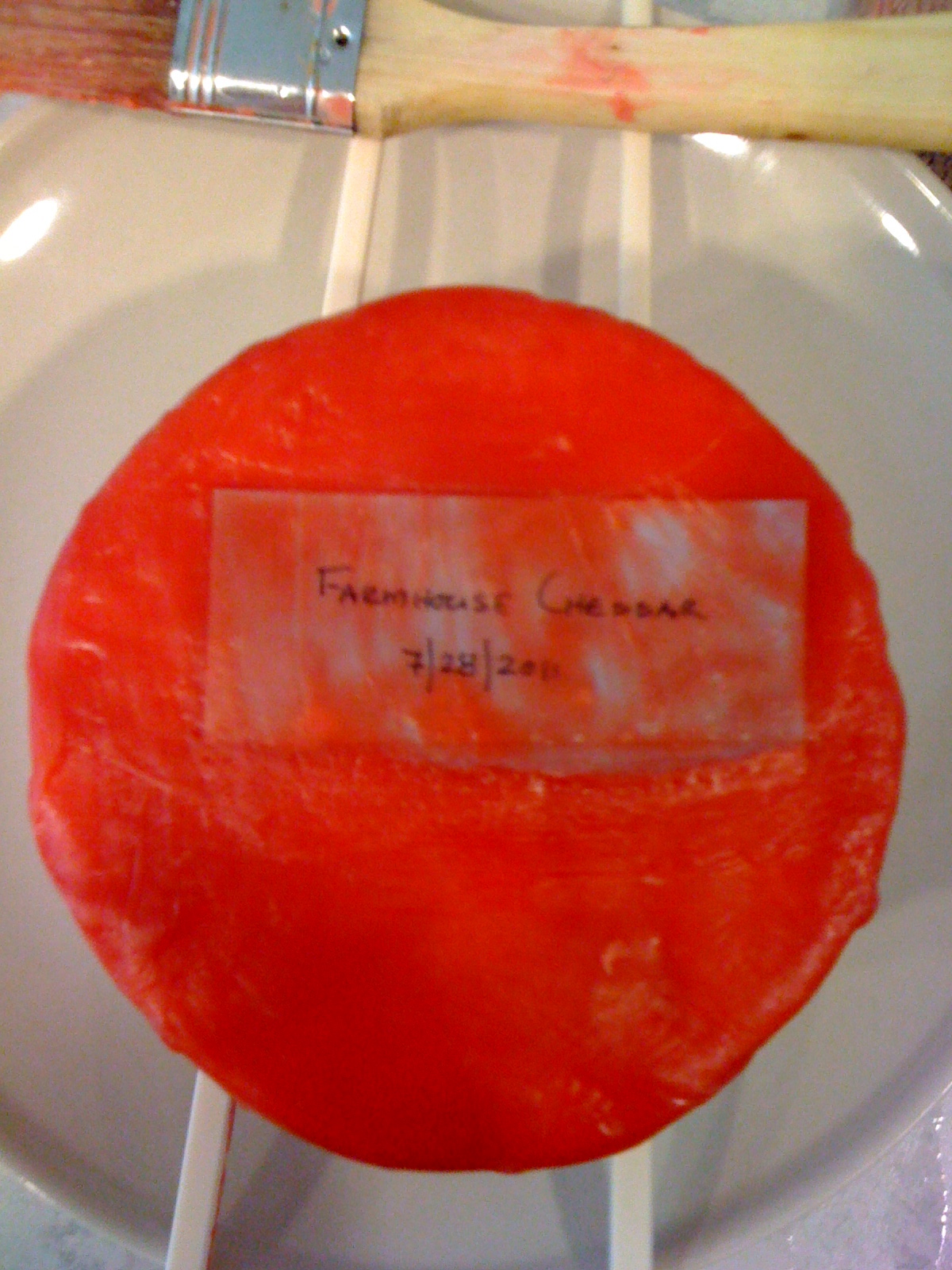
Waxed the cheese today...

Here is the final product from pioneer day - the cheese.  Now it just needs to age for 30 days!


Tuesday, July 26, 2011

Photos from Pioneer Day

Here are just a few photos from our new annual Pioneer Day celebration:


The chicken we caught, killed, plucked, eviscerated, and then ate on Pioneer Day.

Stacy, cooking the chicken we caught, killed, plucked, eviscerated, and then ate on Pioneer Day.

The bread we made while we caught, killed, etc. the chicken we ate on Pioneer Day.
The cheese (both farmhouse cheddar and whey ricotta) that we made from fresh goat's milk on Pioneer Day.

The farmhouse cheddar, drying in the pantry awaiting waxing in a couple of days.

In honor of the mormon pioneers who settled Utah on Pioneer Day, we'll leave out the photos of the cream ale we racked as well.

All in all, a successful Pioneer Day!

Sunday, July 24, 2011

Pioneer Day

Tomorrow is Pioneer Day here in Utah, the day locals celebrate the first Mormon settlers to this part of the country.  In fact, this holiday holds special sway, surpassing even Independence Day in importance, with July 4th commemorated as more of a practice holiday for Pioneer Day, provided it doesn't fall on a Sunday.

One of the great things about Northern Utah, though, is that it was settled as a mostly isolated agrarian society.  Unlike much of the Rocky Mountain West, the folks who moved here came to stay and attempted to be largely self sufficient.  Examples of this exist today, such as the fact that the Salt Lake valley and surrounding metropolitan areas still get all of their water from local sources in the Wasatch Range.  What other western city can make that claim?  If the West is ever required to rely mostly on it's own resources, the Wasatch Front could make a fair go of it (again, a difficult task for places like Denver, Las Vegas, Phoenix, and others).

Since we have moved to Utah and embraced this pioneering self-sufficiency, it seems fitting that tomorrow we will slaughter our first chicken.  S. has been studying the killing and evisceration, and today I made the killing cone, and hung it next to the compost heap:

With those preparations made, tomorrow morning, after we milk the goats and care for the horses, we plan to pull one broody hen from the hen house and try our hand at this.  With luck, we'll kill the bird and celebrate one small measure of self sufficiency with chicken soup in the afternoon.

Saturday, July 9, 2011

Passing...

Conway Leovy     July 16, 1934 - July 9, 2011

Thank you for being my advisor and my friend. And thank you for supporting me in all that I do. I'll never forget some of our last words together, when you told me, after showing me your poetry, photography, and art that there is 'life after science'. You are so right...

Friday, June 24, 2011

Cheese!


Our first batch of chevre (technically fromage blanc since I don't have the chevre molds) is hanging to drain, and within the next few hours, we'll be sampling our first goat cheese.

There were a wide range of recipes that varied in complexity for this relatively simple goat cheese.  Some had you use pasteurized goat milk, or pasteurize your raw milk ahead of time, and others called for using the milk "straight from the goat" and not bothering to heat it to the culture temperature, because it was likely at the point already.  Others called for special "chevre" starter that has included rennet, and others had you use a standard mesophilic starter and liquid rennet.  

And all of this suddenly got me to thinking: people have made these "simple" cheeses before online cheese supply shops and detailed instructions.  How did they do it?

For example, I imagine there was a time when heating a cheese to 170 degrees before cooling it down quickly with ice was technologically impossible, not to mention gathering pure starter cultures.  I am enough of a microbiologist to understand the point of culturing "good" bacteria in your cheeses as a method of preservation, but we haven't always had access to these cultures.  So, how did we do it?

I do know that if you want to wildly ferment cheese, the last thing you want to do is heat it to 170 degrees and kill all the organisms in it.  I wonder if pasteurization became important only after we started mixing the milk from hundreds or thousands of animals before sending it to market.  If you just milked your own goat, and you have assessed the health of the animal and cleanliness of the facility, is it really a worry?  Or are their deadly pathogens waiting in every gram of fresh milk, waiting to kill us all.

I don't know the answer, but I do know that the recipe I used was as simple as I could make it.  Fresh milk, lightly warmed, inoculated with factory cultures...

I'd like to see about getting rid of that last part!

Wednesday, June 22, 2011

The New Arrivals


Just a couple of short days after returning from Seattle, S. and I took the plunge and finally decided to have a kid, and we got her mother in the deal.  Meet Kitty (the Mom) and Cleopatra (Cleo for short) the kid.  They are oberhasli/nubian crosses (hence the bay fur with the airplane ears).

S. and I both have been reading up on goats - how to house them, how to feed them, how to milk them. We visited our vet's barn to see how she does it and got some tips on milking and other issues (she also sold us the goats). However, as we have no real experience with the animals, most of our planning resulted in taking a "wait and see" approach.  We took care of their basic needs by building a milking stand and goat shed (see previous posts) and had a few options for where to pasture them.  Otherwise, we just took the plunge.  We figured "we have horses, so how much different could it be?"

Turns out, pretty different.

E. dropped them off Monday night around milking time to find that S. and I had erected a pretty nice little temporary goat paddock and shed.  The 12'x12' paddock was made of free standing hog panel.  This was certainly not an ideal pen, but we figured it would keep the goats in and the dogs out for the night until we assessed more permanent housing.

E. mentioned that Kitty might "cry a bit" and took off with a wave and a smile.  "Have fun," he said, and walked away with a spring in his step.  He only had six milkers left at the house (down from 10 or 12) so he seemed pretty pleased.  Also a little amused at us.

As soon as E. walked away, Cleo started baying a cute little "Mahhh..." that one expects from a slightly upset goat.  Then Kitty laid in.  Her cry sounded like the below you'd hear from a drunk frat boy yelling at his ex girlfriend's window at 2 AM.  "Brawwww!", "Mehhhhhew!", "Whaaoaoar".  I don't know how else to describe it, except that it was loud, prolonged, and horrible.  Also, since they were housed on the lawn on the south side of the house, her bellow ricocheted off of our house, the neighbor's house, and the ward house across the way.

During the first few minutes, Kitty managed to bend the hog wire out of shape and it became clear that a more permanent situation would not wait until morning.  We took her out to milk, and found that as long as we had both in hand, they were quiet and inquisitive and very easy to manage.  She milked fine, producing about 20 ounces after finally figuring out the new milking stand (turns out, we had it backwards - she is used to being milked from her right side).

After the milking, we brought in the horses and turned the pair out in Maisy's paddock, where the cacophony continued.  And while the volume and frequency stayed about the same, at least we had remedied the echo, a marked improvement!

Before bed, we brought the dogs out (leashed!) to see what they thought of the goats.  Both of them barked and lunged at the goats, but unlike the horses, the goats stood their ground, stomped, and snorted.  In the end, this might make all the difference for Captain, to have an animal that isn't intimidated by all his barking and circling.  We will have to see.

After the dogs, it was off to bed.  I slept fitfully given the dogs barking and Kitty braying, and S. slept not at all, but since that first night Kitty and Cleo have settled a bit, the dogs are getting accustomed to the new arrangement, and we've milked Kitty three times.  So far, so good...

And I am surprised to learn how much different the goats are from our horses.  Where horses are aloof and a bit standoff-ish, the goats are immediately curious and companionable.  If you open a gate, the goats crowd out, then stand next to you or follow you around.  Yesterday, S. and I spent some time in the back pasture with them, sitting on logs and watching them browse in the bushes.  Within a few minutes, Cleo was sitting at S.'s feet, curled into a comfortable ball chewing her cud.  That was completely unexpected.

There are horse people.  Turns out, there may also be goat people.  And I think I'm one of them.

Monday, June 20, 2011

Milking Stand

 
Stacy and I finished the milking stand yesterday, in preparation for our two new goats.  

The "table" part of the stand is a piece of furniture we've been carting around for as least as long as I have known Stacy, and Stacy has had it longer than that (so we are talking 25+ years here).  The table came from a barn in New Jersey, reportedly used to kill chickens (we've always just called it "the chicken killing table").  It has be re-purposed as a desk, a kitchen table, a banquet, and an outdoor plant stand.  We have cut down the legs once, added taller legs, and cut them back down again.  Finally, it has found it's new home, not as the "chicken killing table" but the "goat milking stand."   

The remainder of the stand is various other pieces of re-purposed materials.  The front slats are mostly from some bench parts stolen by kids and left in the yard of our last house (we tried to locate the owners, to no avail).  The feed box is from cedar planks left over from the fence we built at the new place.  It really is a "franken-stand", but to me, it looks beautiful.  We didn't even go to Home Depot once, as it was created from materials already on the farm.  

I think I finally know why Stacy dragged the table from New Jersey, and we dragged it from Iowa (after selling nearly all of our other stuff) to Seattle and then back to Utah.  It has finally found it's true purpose.

Now, we are waiting on a phone call from the owner, and then we'll go pick them up.  Waiting is so hard!

Goat House


- Posted using BlogPress from my iPhone

Tuesday, June 14, 2011

Assessment

This morning I had planned on visiting with my old graduate school advisor for one more time before I left.  He is dying of cancer, and I figured it was probably my last time to see him.

Earlier, his wife called to tell me that he isn't feeling well and needed to cancel the visit.  She went on to say that he really enjoyed our last visit, and left me with the impression there would likely be no opportunity to reschedule.

Which means our last visit was probably our last.  I hope that isn't the case, but I suppose in reality that is always a possibility, with anything and everything.

With that in mind, since I am leaving Seattle the day after tomorrow, I thought I would make a list of my accomplishments and lessons learned while here, both personal and professional.  Since this could very well be the last time I ever come here, I am pleased that I seemed to have made the most of it.  In no particular order, and cognizant that I am missing some things:

  • Met with VPL colleagues and outlined a research agenda.
  • Spent over an hour visiting with my graduate advisor in his Lake Washington home, probably for the last time.
  • Spent time with T. kayaking around Lake Union and Lake Washington
  • Visited with C&T (and little D!) many, but not enough, times.
  • Vacationed with S. at the Mother Earth News fair.
  • Had lunch at the Crab Pot with S.
  • Took a rowboat out on Lake Union.
  • Walked to Pike Place Market nearly every day, sometimes twice per day.
  • Walked a lot (to UW, back from UW, to Pike Place, waterfront, etc).  Conservatively, I've clocked at least 60 miles since I've been here.
  • Took a ferry ride.  Might take another one.
  • Saw Wendell Berry at Benaroya Hall.
  • Had Pizza Lunch with UW folks, and caught up with some old friends.
  • Went to the Experience Music Project twice (once alone and another time with my sister).
  • Hung out all day at the Folk Life Festival.
  • Ate at the Sound View Cafe (twice!).
  • Visited Pioneer Square and the International District with S.
  • Got a massage (twice!).
  • Ate mini-donuts (more than twice!).

Lessons Learned:

  1. I've been reminded of the benefits and liabilities of working at a research university.
  2. After seeing the level of activism in the city regarding lifestyle changes and the focus on the environment, I am encouraged about the direction we're heading.
  3. After living with a perpetually sore neck and jaw (stress), I have learned the value of a good massage.  I'm also learning how to take better care of myself.
  4. Given access to plentiful good food and relatively cheap beer and cocktails, I tend to indulge too much in both (erp).  Looking forward to more work back on the farm!
  5. I've been deeply reminded of how much Utah is my home, and that I have developed a very strong sense of place there.
  6. I've learned how lucky I am to have the neighbors we have.
  7. I've learned how lucky I am to have the colleagues I have.
  8. Finally, I've become keenly aware of how important our move the farm has been.  I am looking forward to getting back and getting busy.
So, that's the list for the first month of sabbatical in Seattle.  Not too bad, and since sabbatical officially starts on July 1, I'm already ahead of the game.

On Thursday, I'm off to Saint Louis for the Council on Undergraduate Research Business Meeting and then back home.  And then the real work begins.


Saturday, June 11, 2011

Turn-around tourism

During my last week or so here in Seattle, I've been walking the waterfront and through the Market every day, because, for some reason, I just can't get enough of it.  The mixture of Pike Place's working waterfront and cheeky tourist stop just thrills me.  If you sit at the bar a Lowell's, you'll see fresh-off-the-boat fisherman sitting next to coiffed socialites.  Quite the contrast.

And, largely, the Market is unchanged since I first came to Seattle 27 years ago.  It seems that the hard-won vendors slots at the Market encourage the younger generation to continue the tradition, since many of these are the same businesses yet with decidedly younger purveyors.

Some things have changed, at the Market and in and around Seattle.  S. and I found to our utter dismay that Elliott Bay Book Company is no longer in Elliott Bay.  It isn't out of business, just moved to Capitol Hill.  But what is Pioneer Square without EBC?  Even my other Pioneer Square favorite, Metzger's Maps, moved - in this case, up to Pike Place.  The move seems to have erased a lot of their inventory of true collector maps, and most of the store caters to tourists with travel books and maps and the like.  Still a fun store to poke around in, and arguably more useful to both the actual traveller and the armchair variety.  But I do miss the quirky, sometimes dusty memories I have from the old place.  The new place is a little like going into Idaho Book and Supply back home.  Which actually says a lot for Idaho Book and Supply.  I'll have to go there more often!

I did find an intriguing book in Metzger's called "101 Things You Gotta See Before You're 12" and I thought "Oh no, another impossible list of travel adventures I'll never get around to...this one with a deadline!"  What a horrible thing to do to a kid.  Especially if the kid reading it just passed 12 (or is almost 40).  What if they didn't get to everything?

When I opened the book, though, it was filled with things like "visit a quality second hand store", "go to a petting zoo", "visit your parent's home town", "go to an art gallery", etc.  In fact, I am sure a motivated kid could probably complete 99% of the items in the book without ever leaving their home town except to hit "a national park", "a gateway to the new world", and things of that nature.  I was even more excited to say that I have, in fact, done all 101 "Things You Gotta See Before You're 12" and I am pretty sure I got them done all before I finished my 12th year, picking up the last few during that first visit to Seattle 27 years ago.

But now I have a new goal: I have not completed all 101 "Things You Gotta See Before You're 12" in Ogden, UT.  And, given I'm just starting my sabbatical year, I might just be able to pull it off.

I'll tick off a few of the more difficult ones, like "see an ocean" while I am here, and then get the rest after I get home.

And since the book even comes with stickers, I am motivated.

Wednesday, June 1, 2011

What do we have on the ship that's good?

After nearly a week immersed in Wendell Berry and discussions with my colleagues about the state of the world, I am starting to get fatigued with a steady diet of doom and gloom.  At least my friend T. has a sense of humor, though an admittedly dark one: he calculated that with a 2.3% growth rate in energy usage, we have 1100 years before the surface of Earth gets as hot as the surface of the Sun.  Gotta love that exponential.

Still, it gets me thinking that I need some carrots to go with my stick.  I've seen all the data, I understand the projections, and I know everything is going to hell in a hand basket.  The climate is shifting, we are running out of oil, the population is exploding, people can't get enough food and water, wars, famine, disease, death.  And we had better do something about it, or else.

Faced with all of this, I am reminded of the quote from Gene Kranz when faced with the disaster of Apollo 13: "What do have on the ship that's good".

Some things I have noticed here in Seattle:

1. Dozens and dozens of people on their bicycles, rain or shine.  The density of riders is not as high as other cities, like Bejing or Amsterdam, but it is high enough that nearly all the streets have bike lanes and road signs (with mileage!) for the riders.
2. Mass transit is packed, and I have been having a relatively easy time of getting from A to B (though UTA still trumps KC Metro for service, go Utah!)
3. Pike Place Market has booths from local farms.
4. Nearly every neighborhood has a year-round farmers' market.
5. My friends don't think we are crazy, and want to get a few chickens at their house (and damn the covenant!)

Compared to the Seattle we left eight years ago, things have really changed.

With so many positive changes, I thought I would spend some time reading about the future as we want it to be, rather than as we fear it to be.  I did a web search, and found this:

http://www.youtube.com/watch?v=0USn7eufXps

And, surprisingly, that seems to be as good as it gets.

So, perhaps it is time to invent something that isn't already on the Internet?  Where is S. when you need her?

Monday, May 30, 2011

What Matters?

A quote from Canadian ecologist Stan Rowe from Wendell Berry's book of essays What Matters?:


"After all, well-educated people, not illiterates, are wrecking the planet.  Schools and universities are morally bankrupt [and] most research is worthless busywork..."

Berry himself continues:

"I would add that some research is worse than worthless; it contributes directly to the wrecking of the planet."

I thought of this when a friend and physics colleague pointed out that...

"...people expect science and technology to solve the current problems, but if you walk the halls of physics programs in the nation and look for what is being done about this," -- This being peak oil, environmental damage, climate change, the population "hockey stick", etc -- "you hear nothing but crickets."

My dissonance is further compounded by a recent blog post of one biologist claiming that the entire field of astrobiology is an irrelevant exercise designed to secure NASA funding.  As I posted a few pointed Facebook comments defending my field of research, the two quotes above came back to me.

Meanwhile, S. is on the farm holding back the flood waters and trying to keep our place "afloat" through a wet spring, while I sit in an apartment in Seattle worried about my veggie starts and baby chicks 800 miles away.

So, what matters?